Pages

Showing posts with label Nelson. Show all posts

16 March 2023

Bad Hair Day?

If you think you're having a bad hair day, then spare a thought for these little fellas who have permanently wayward hair. 


However, crazy hair and all, they are super cute! And those rebellious locks simply add to their charm.


In Richmond, a township just south of Nelson, is a popular country gift shop by the name of Eyebright.  


And it's here, at Eyebright, that a group of guinea pigs reside in a Guinea Pig Village called, Wendelton.


Wendelton has several miniature buildings, such as; Lord Guinea School, The Piggy Bank, Dr Doolittle's Surgery & Wendelton Maternity Unit, The Guinea Guinness Pub, and The Piggy Wiggy Hair & Beauty, plus others.

Maternity Unit


The guinea pigs are very friendly and rush to welcome you, hoping you'll have some food. Mikah, my wee granddaughter, fed them little bits of carrots (that we got from the Eyebright Store), and this gave her an opportunity to give them a little pat. 


This well-known community of guinea pigs hosted a wedding in 2005, when Hansel & Petal exchanged vows with over 150 guests to witness their special occasion, (you can view it by clicking this link ) 

The owner of Eyebright (Peter Owen) wrote a book about them, named 'The Wendelton Book'.

If guinea pigs aren't your cup of tea, Eyebright is still worth a visit. It's one of Nelson's iconic attractions, especially around Christmas, when many people come to admire their Christmas displays.

An added treat, are the gorgeous cottage gardens, they're full of colour with old and new plants mingling together. 

On a side note:

When I was a youngster I had guinea pigs as pets but I really didn't know much about them, other than, they were ALWAYS hungry and squeaked whenever they heard you, to remind you to feed them!

While writing this blog I thought I'd google some facts about them. I'll bullet point a few things I discovered ...

  • When guinea pigs run and leap (which they often do when they are happy), it's referred to as popcorning.
  • Guinea pigs have four toes on their fore feet and three toes on their hind feet.
  • Guinea pigs are very social and only sleep for short periods, they're active for 20 hours in a day.
  • Guinea Pigs originate from the Andes in South America.
  • Even though male guinea pigs are called boars and females are called sows, they are rodents. Their scientific name is ‘Cavia porcellus’, which is why they are sometimes referred to as ‘cavies’. The word ‘porcellus’ is latin for ‘little pig’. This name may have come about because of the pig-like squeaking noises they make.
  • Guinea Pigs don’t get on with rabbits. Rabbits bully guinea pigs, and they have different needs. Rabbits can also carry diseases which can be very harmful to guinea pigs.
  • They like to chat to each other. However they do like human affection, but guinea pigs need to be with others guinea pigs and should always be kept in pairs or small groups. 
  • Baby guinea pigs are called pups. They with their eyes open, and with fur. Plus they're able to run when only a few hours old. 

    10 March 2023

    Wai-iti Domain - Freedom Camping

    Not far south from Nelson (about 30kms) along SH6 is a small settlement named Wai-iti. And just before the Wai-iti Bridge if you turn left, you'll find yourself at a roadside picnic area. It's a decent size spot with several large totara trees and a couple of kahikateas offering plenty of shade.


    A little further along is the Wai-iti Domain/Reserve. Although there's oodles of room it might be unsuitable for bigger rigs as the left hand bend is a little tight, and there's a few over hanging branches as you approach.


    The Wai-iti Domain/Reserve is a massive area with mature trees bordering the perimeter. It's dog friendly and kids will like the large, flat area to ride their bikes or to kick a ball around. There are toilets and rubbish bins and it's free to stay!


    Behind the reserve is a forest walk, which loops back to the start. 


    The walk begins by climbing a gentle incline that hugs the side of the hill. After about half an hour (less if your fit, or longer, if like me, you're a bit of a stroller!) you reach the top. 


    Being autumn - it was the season for toadstools.


    It's an easy walk, the track is wide and covered in pine needles, plus there's birdsong to enjoy. With no 1080 poisoning to worry about, dogs are safe off lead to run around and explore. 


    After awhile, Oakly started to look for water. We came across a forestry water supply but seeing the colour of it, I decided being thirsty was a better option than to drink from it!


    All up, the walk took about an hour and a half, which included taking a wrong turn. We ended up at a forestry skid site, which wasn't a complete waste of time as it had a fabulous view. 


    At the end of the walk we wandered over to the Wai-iti River (Wai-iti = low water). And true to its name, the river was shallow. In the warmer months it's been known to have toxic algae, however after recent floods it was safe for the dogs to cool off and have a well deserved drink.


    4 March 2023

    Away With the Fairies

    You don't have to believe in magic to enjoy a visit to a Fairy Grove. Whatever your age - young or old, spending time in a charming woodland is sure to delight.

    Not far from Nelson, in the suburb of Stoke, is an enchanting Fairy Grove. The fairy houses and fairy doors come in all shapes and sizes, restricted only by one's creativity and imagination. Some hang from branches, others are attached to tree trunks, while some rest against the base of trees. 


    My granddaughter and I enjoy our visits to the Fairy Grove. Mikah loves to peek inside each little house, as some of the dwellings have tiny accessories, adding to the wonderful world of make-believe.


    Some log-benches have been arranged in a semi-circle, providing seats for a picnic, or somewhere to relax and let your inner child enjoy the moment.


    Fairy-Land wouldn't be complete without toadstools. And fortunately someone had that thought and made some delightful toadstools. 


    However, not to be out done ... nature has added clusters of dainty white toadstools flourishing under the canopy of tree branches.

    And better still, it's dog-friendly (always a winner for me)! 


    There's a path running through the reserve, which passes a shallow swimming spot, it's a perfect place for dogs to cool off. A few resident ducks have made it their home and weren't at all bothered when Oakly and Boo joined them for a swim.


    15 January 2022

    Sun-sational

    Sunny Nelson has certainly lived up to its name this summer! When temperatures became too hot to walk the dogs during the day, the best thing to do was head to the river!


    Fortunately, Lee Valley near Brightwater is only a 20-minute drive from home. As soon as I picked the campervan keys up, the dogs were off - they couldn't get in fast enough. When we arrived I was surprised to see we had the whole area to ourselves. Bliss 💚


    The water looked inviting ... clean, deep, and a gorgeous emerald green.


    Once the dogs had cooled down we went for a walk along the river trying to stay in the shade but also close to the water to cool down whenever they needed to.


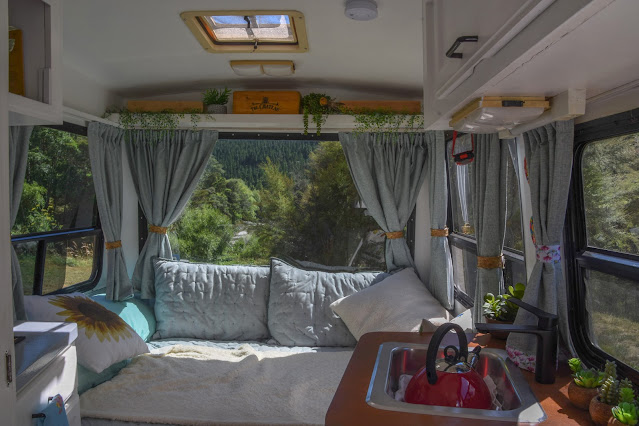
    Afterward, we relaxed in the camper, soaking up bush views and listening to the sound of summer; cicadas clicking, birds chirping, and the burbling river closeby. 

    An ideal way to recharge the batteries.

    27 October 2021

    Lion's Mane Jellyfish

    Over the last couple of weeks, Tahuna Beach has seen lots of Lion's Mane Jellyfish washed up along the shore. These fascinating creatures are also known as the world's largest jellyfish and can be found in cooler waters around the coast of New Zealand.


    The name Lion's Mane Jellyfish comes from the mass of long, yellowy-brown tentacles that look like the colour of a lion's mane.

    They have a short life span of one year or less and during that time their colour changes. The younger jellyfish are a pale pink or yellow colour, then as they age they turn a deep reddish-brown.


    These beautiful marine creatures are mostly made up of water - they have no brain, no bones, no heart, nor eyes. Although they don't have a brain they're able to function using sensory nerves. Their tentacles, which have tiny, toxic, stinging cells act as a net to capture and paralyse prey before eating them. Food is digested quickly and an opening found underneath their bell-shaped body acts as a mouth and is also used to discard waste.

    Their diet consists of plankton, small crustaceans, fish, and other jellyfish. Due to their size, the larger jellyfish don't have many predators but the smaller ones can be eaten by large fish, sea turtles and sea birds. 

    Lion's Mane Jellyfish don't purposely attack people, most stings happen when swimmers accidentally brush against them. Even those washed up onshore can sting, although the sting isn't fatal it can be painful. The recommended treatment if you get stung is to flush the area with seawater to rinse away any tentacles or stinging cells. Then apply heat, to permanently inactivate the venom. Others say dabbing vinegar onto the painful area will ease the stinging sensation.

    Jellyfish can move short distances by contracting and relaxing a ring of muscles around their domed-shaped body or bell. The muscles open and close the bell, drawing in water and then expelling it, which pushes it forward. However, jellyfish are mainly controlled by water currents. As the jellyfish gets to the end of their lifespan they aren't as resilient and move to shallow waters to avoid the wild ocean currents. And because they're at the mercy of sea currents it's common to see them washed up on beaches.

    Did you know a group of jellyfish is called a smack but when huge numbers of jellyfish appear suddenly it's called a bloom?