Not
far from Twizel, about 30kms south, is a little town named Omarama (in Maori it means ‘a place of
light’- referring to the pure and clear skies). Omarama sits at the southern
end of the Mackenzie Basin.
There
were two reasons I was looking forward to visiting this area.
1). 'The Clay Cliffs'
&
2).
To see the lupins along the Ahuriri River.
When
we made the decision to stay at Lake Pukaki until after Christmas, I decided to take a day
trip to Omarama. I didn’t want to miss seeing the lupins at their best.
Just
north of Omarama and10kms west are the natural rock formations known as ‘Omarama’s
Clay Cliffs’.


The 'Clay Cliffs' are well sign posted, giving you plenty of warning that the turnoff is approaching. I
turned off State Highway 8, into Quailburn Road and then into Henburn Road,
which is an unsealed road. There was the odd patch of corrugation and a few pot holes, however it wasn't as bad as I'd been led to believe.

It’s
a private road - the farmer has placed an honesty box for a $5/vehicle admission fee, to help with the upkeep of the road. You can also pay at the Omarama i-SITE.


In the distance I saw a farmer moving a mob of sheep, as they moved onto the road I slowed down to let them pass. But with a couple of whistle commands the dogs skilfully moved them off the road. Where would farmers be without their dogs?


The
landscape was beautiful, so typical of the magnificent Mackenzie Basin. Although the briar
roses had finished flowering they managed to fill the air with sweet
perfume.
And as for the Clay Cliffs … WOW!


And as for the Clay Cliffs … WOW!


The surrounding vegetation made a striking contrast against the golden clay cliffs towering above. The track leading towards them, was as expected, dry and dusty, but it was an easy walk.


These
geological wonders are a mass of tall, sharp pinnacles separated by steep and
narrow ravines made up of layers of gravel and silt.


Originally
they were formed by the flow of ancient glaciers over two million years ago.
That sounds like a long time ago but when you compare it to the 250 million
year old surrounding mountains, they’re relatively young!


If you're planning to visit the Clay Cliffs, remember to wear sneakers or footwear with some grip. I climbed up as far as I could go - the path was steep and over loose rocks (varying in size). It was slippery in places and a concerned tourist told me to be careful ... but I was mostly worried about my camera!

 |
| Looking out over the Ahuriri River bed. |
 |
| The view looking up to the sky. |
Beside
the Clay Cliffs runs the braided Ahuriri River. The river travels from the
Southern Alps and flows for 70 kilometres through the southern part of the
Mackenzie Basin before reaching Lake Benmore.


Ahuriri River is popular for brown and rainbow trout fishing.


The clouds were getting darker and I was hoping the rain would hold off for a little longer.

On the walk back to the car I noticed a few lupins had past their best. Seed pods were appearing. The brair rose had also finished flowering and most had rose hips forming. There were still plenty of vipers bugloss in full bloom - maybe they were responsible for filling the air with such a sweet, alluring fragrance?


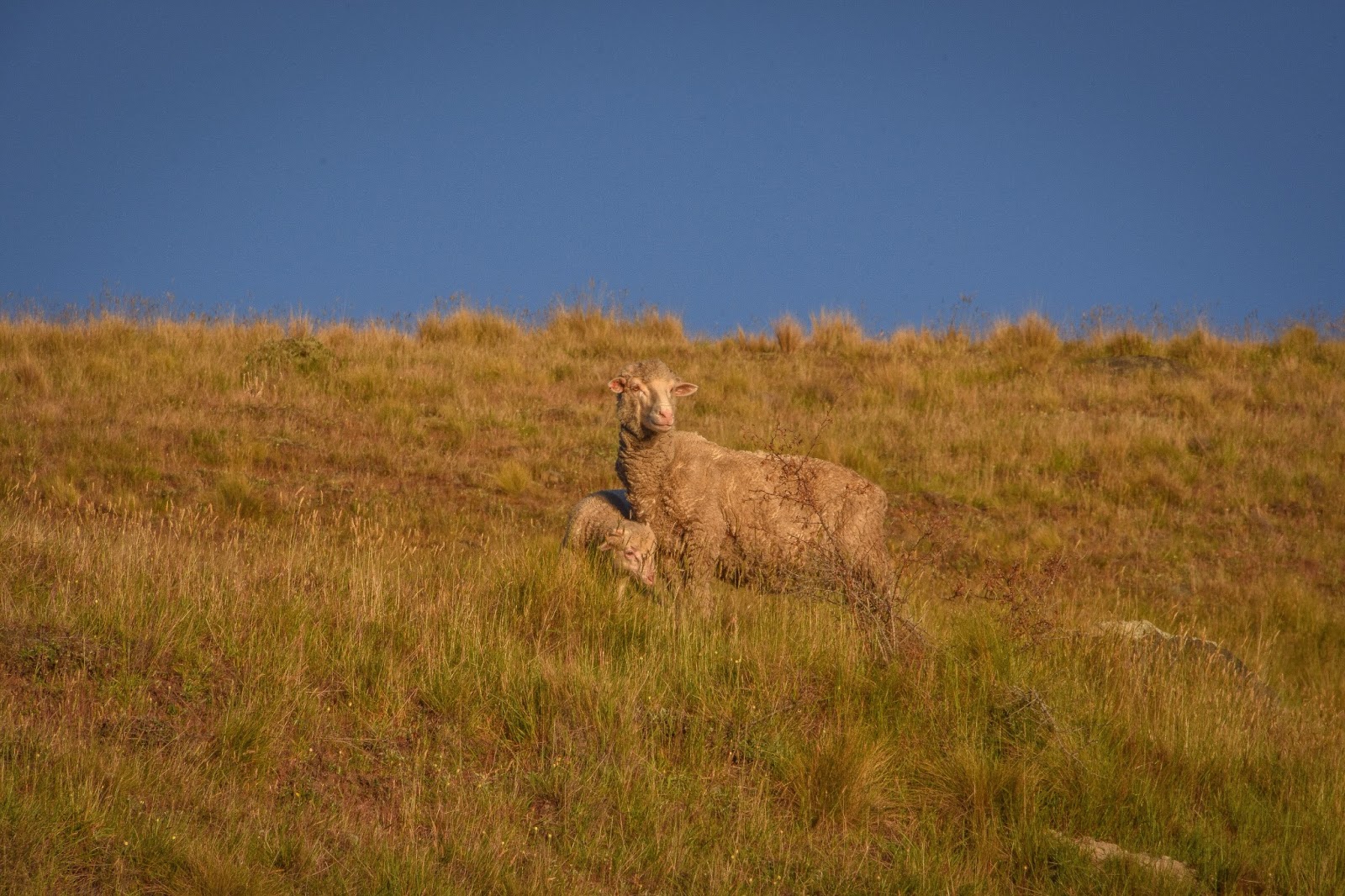
And I had to stop to take a photo of these merinos, although they weren't very obliging - a bit camera shy.

I drove to The Ahuriri Conservation Park hoping to walk along the
riverbed among the lupins but I couldn’t cross over a creek running to the side of it.

Although picturesque, the lupins smothering the riverbanks are a concern for environmentalists. The river is the breeding ground for some endangered birds and the masses of lupins alter the river flow and provide hiding places for predators.
However lupins aren’t all bad and not everyone holds the opinion of the environmentalists. These Russell lupins attract many tourists into the area. And when farmed they’re a nutritious fodder that requires little fertilizer to grow in the infertile soil of the high-country.

As I
was looking for possible places to jump over the creek, I heard a soft whirring overhead – a
glider silently glided above. Glider pilots love the air above Omarama. World and national gliding records are regularly broken here because of the clear, empty skies and obliging updrafts.