Pages

Showing posts with label Taylor Dam. Show all posts

6 October 2019

Beavertown

Many years ago there was a town in Marlborough known as Beavertown or The Beaver. Nowadays, its known as 'Blenheim'. Back when the settlement was establishing, there were frequent floods and the township was often surrounded by floodwater. The buildings resembled beaver lodges, which led to it being named Beavertown. And I guess that also explains why Blenheim's town mascot is the beaver.

As a result of repeat flooding the Taylor Dam was built. It's the largest flood protection dam in New Zealand. Stop banks near Blenheim township were also made, which has created a large area known as Taylor River Reserve. It's a popular spot for walking, exercising dogs, cycling and jogging - the reserve has a network of paths, which go as far as the Taylor Dam.

The other day, while Bernie was sleeping after a night shift, I got up early and took the dogs for a walk along the Taylor River. First, I stopped to get a sunrise photo of the Wairau River. I was standing on the little one way bridge (Ferry Bridge) in Spring Creek, close to where the bus is parked.
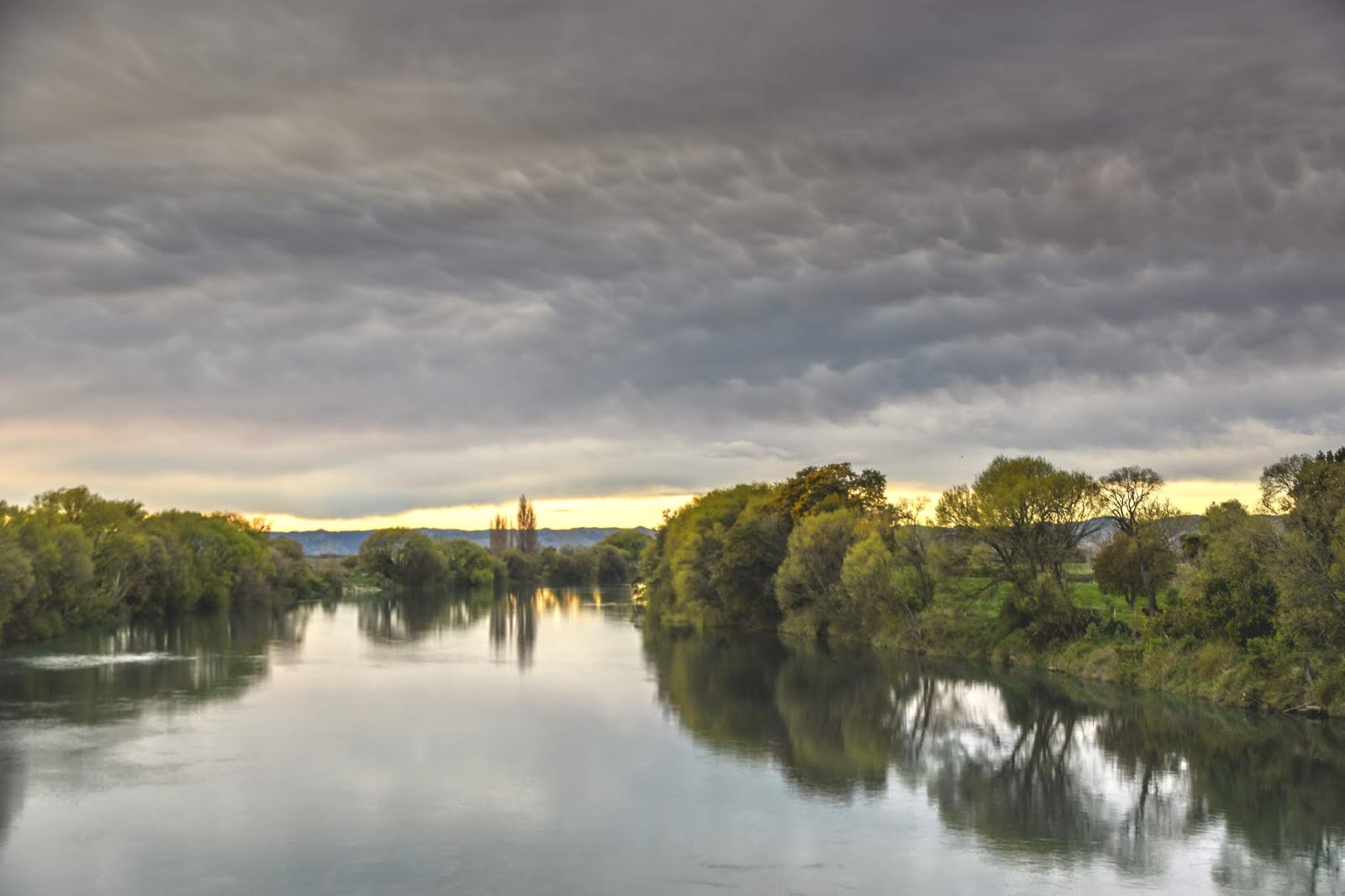


It was good to start the walk early. There were few people about and the temperature felt refreshing.

The Taylor River was named after a New Zealand surveyor, Joesph Taylor.
Beside the path, one of several information boards stated, Taylor Dam was a 10km walk. The dogs would be fine with that distance, providing we took our time and stopped often so they could cool off in the river and have a drink.

Blenheim Riverside heritage railway follows the river from Bradshaw Park into central Blenheim.

After about 3km we left the residential area and the first signs of rabbits appeared. As mentioned before, it was good to be out early as there weren't many people about, however  that meant we were first on the scene to surprise any rabbits. The dogs were delighted and thought they'd arrived in paradise. They darted about with their noses glued to the ground. The funny thing was, they were so busy sniffing and looking downward that they missed seeing four rabbits. I noticed them and was grateful that my buddies didn't.


We carried on, albeit the dogs needed a lot of coaxing as they were fixated on a particular pile of rocks ... certain a rabbit was hiding in there somewhere.
Further along, a sign warned of possible Chilean needle grass ahead. Knowing this invasive weed will begin seeding soon, we turned back. I didn't want to risk it. Boo had some trouble with grass seed a few summers ago (read here). Now, if we know it's in an area, we steer clear of it.


Local school children have written poems about the Taylor River, which have been made into plaques and embedded into boulders along the walkway. What a great idea.


Even though we didn't walk to Taylor Dam, I was still keen to see it (again). So we drove instead. Once you turn into Taylor Dam, on the left is a small area to freedom camp. There are only a couple of camping conditions; you must be self contained and the maximum stay is two nights. Dogs are allowed providing they're on leads.


I took this pic with my car parked in the freedom camping area to show perspective of space.
Behind the dam a small lake has formed. Although it's not suitable for people to swim in, it's the perfect place for bird life. It's become a sanctuary for teal, black swans, pukekos, mallard and paradise ducks and shags.


There were lots of swans with their young ones (cygnets) in tow. A couple of years ago when we visited Taylor Dam, I wrote a blog with information on the dam and a few things I found out about swans. If you'd like to read that, click 'here'.


The stop bank above the lake was draped in blue wildflowers and wild sweet peas that were about to flower. Just imagine the fragrance in a couple of weeks time when those sweet peas are in bloom!


By this stage the dogs looked as though they needed a cool drink and a rest (I know I did). It was time to head back to the bus.


8 October 2016

Taylor Dam

Taylor Dam, 6 km's out of Blenheim is beautiful. There is a place to camp on the left as you drive in and although it looks like there are many great spots near the lake, you can't actually camp there.
The lake is teeming with bird life. 


The place available to camp is to the left where you can see a camper van. The road you can see circles the pond.
There were lots of swans with their young ones enjoying the pond. The male swan, called the cob, helps the female, known as a pen, to look after their babies, called cygnets until they are a year old. The young don’t spend more than one day in the nest once they hatch. If the pen is still brooding eggs, the cob will take care of any cygnets that have already hatched, leading them directly to the water. Though they can swim from birth, cygnets may sometimes ride on the backs of their parents or take shelter under their wings until they are old enough to strike out on their own.


It is normal for swans to swim with one leg tucked onto their back. People are often concerned that the leg is broken or deformed but the swan is perfectly fine. 
Swans will often stretch one of their legs whilst swimming and instead of putting it in the water, they will tuck it up onto their back. 
It has been suggested that this behaviour may play a role in helping to regulate the body temperature of the bird. The legs and feet are the only part of the swan not covered in feathers so the blood vessels are in closer contact with the air. The large surface area of the webbed foot makes it easier for heat to be transferred from the body to the air, cooling the swan. This heat exchange could also work the other way, with the feet absorbing heat from the air to warm the bird.  


The Taylor Dam is a flood protection dam and recreational reserve located to the south west of Blenheim.
Most of the year, the Taylor River only has a modest flow, and even dries up over sections of its course, however it can rise very rapidly during heavy rain. As a result, Blenheim was flooded in numerous occasions, and this possibly contributed to being named The Beaver, or Beavertown. 
In March 1963 the Marlborough Catchment Board began planning for the construction of the Taylor Dam and work took place between 1964-1965 as flood protection for Blenheim. Officially opened on 30th November 1965, the structure is the largest earth flood protection dam in New Zealand. 
Behind the dam, a small lake has formed, and provides an important habitat for waterfowl, with black swans, coots, mallard ducks, shags and other species present. Eels are also present in the lake, and brown trout have been released in the past.


Picnic tables are provided at various locations in the reserve and swings and toilet facilities are available in the north west corner of the reserve. 
Dogs are permitted at the Taylor Dam provided they are kept on a leash.


Numerous large trees are planted around the lake, providing shade in summer, although most of the trees are introduced rather than native species. Various species of oak, pine, and willow are among those present. An area of native shrubs is located near the toilets.
To the south, upstream from the dam itself is a large flat area with mature pine trees a few minutes walk from the end of the vehicle track around the dam. This area is the former Omaka Domain recreation reserve.
To the north, the Taylor Dam reserve connects with the Taylor River Reserve which provides a walking and cycleway that extends to Riverside Park in central Blenheim.