Pages

4 January 2017

Bainham Store & Sailsbury Falls

Bainham Store is nestled in the heart of the Aorere Valley, 15 minutes inland from Collingwood on the way to the Heaphy track.
This general store and post office have been providing essentials to the Bainham community and travellers since 1928.


The store has been in the same Langford family for four generations, since it opened in 1928.  Edward Langford was the initial proprietor, followed by his grand-daughter Lorna who ran the store and post office for 63 years. Lorna retired in May of 2008,
handing over the reins to Sukhita Langford, who hopes to do both the community and family proud by continuing the traditions that her great grandfather instilled more than 80 years ago.


The storeroom has been turned into a gallery space for local artists to exhibit their work.
The gallery is stacked with a great collection of nostalgic items, which all add to the charm and beauty of the historic store.


Time has worn the outside of Langfords Store, but inside time has stood still. Memorabilia, dry goods, books, sewing bobbins, gumboots, old posters, old price lists and crockery compete for attention from stacked shelves and walls in the tiny Golden Bay shop.


The post office beside the shop is also worth a visit. It’s like stepping back in time!


As we climbed back into the car we noticed a road sign indicating a swing bridge 5kms up the road towards the start of the Heaphy track. We decided to go and take a look.

The swing bridge no longer exists as it was swept away in the 2010 flood. Despite there being little evidence of any swing bridge the trip wasn't wasted. We followed a track across a farm paddock which led to a rocky path winding down to the Aorere River. What a magnificent swimming hole. The water was deep and crystal clear. 


To the right and tucked behind a ledge of rocks was a waterfall, 'Salisbury Falls'. Water crashed over the edge of a rocky ledge into a small pool below. The pool narrowed to a stream and flowed into the Aorere River. 


The still air along with the sun's heat convinced Bernie to strip off and join Paddy in the river. The only reason he didn't scream after he dived in was because some other visitors had arrived. According to Bernie, the water was so cold it took his breath away. That didn't stop Paddy from spending the next half an hour chasing any stones that were skimmed into the water.


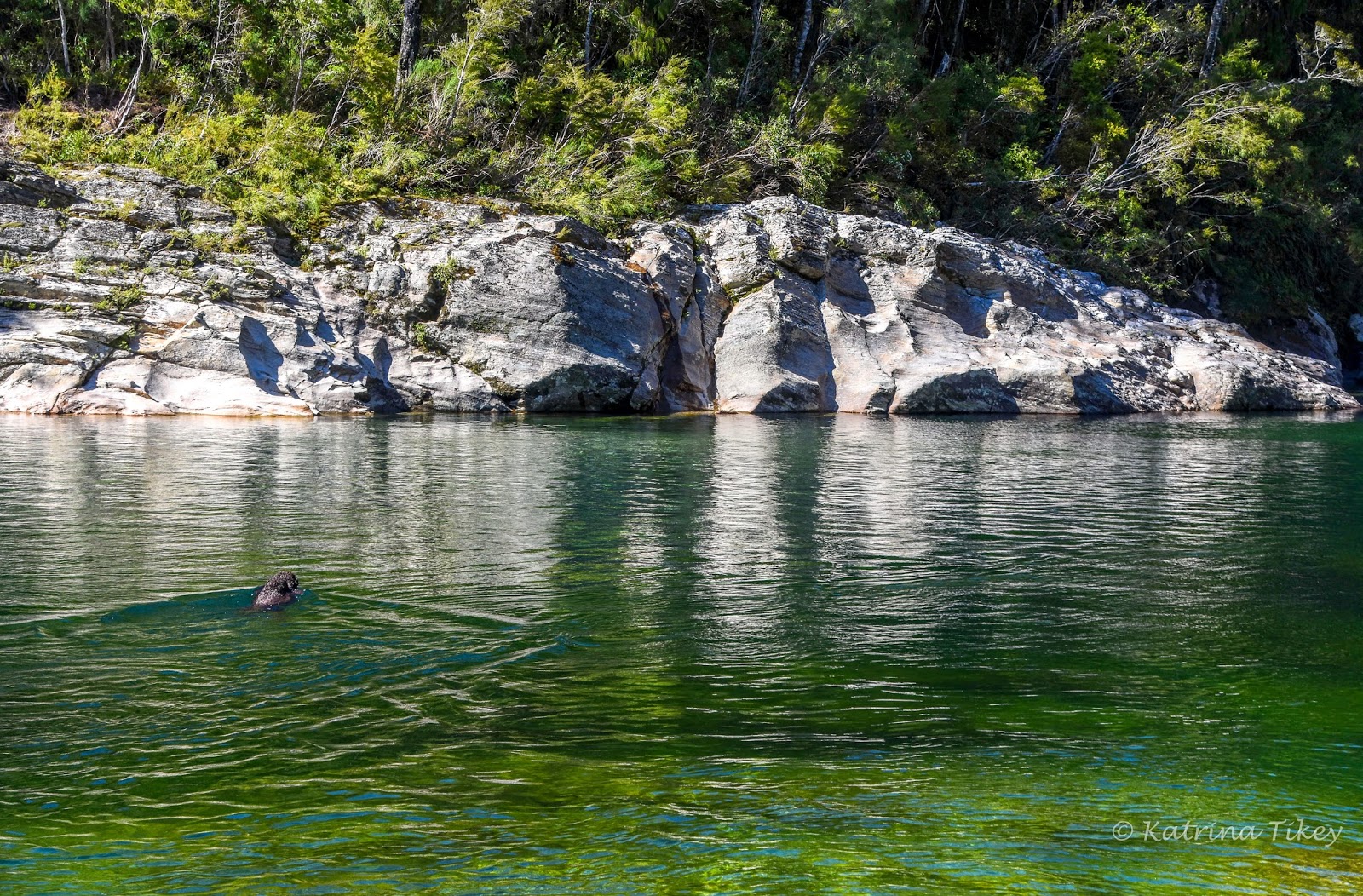

Finding the Salisbury falls and this amazing swimming place was the highlight of my day. I'd definitely recommend going there even if you don't intend having a dip.

Waitapu River Inn

Three kilometres out of Takaka we found a fantastic to place to stay. Waitapu River Inn (situated a couple of hundred metres off the main road) is a pack backers, restaurant and bar. In its previous life it was known as the 'Globe Hotel'. 
The area to park, filled each night with overnight campers but by mid morning most had packed up and left. It was perfect for us - easy access, flat well kept grounds and a lovely rural view. We woke to cows plodding along to and from the milking shed, across paddocks littered with buttercups.


Waitapu Wharf Road is a sealed road ending at an old wharf. The Waitapu Wharf was once a thriving fishing port and played a major early role in the early history of Golden Bay. A tramway began operating in 1882 between Waitapu Wharf and East Takaka, primarily to carry timber to the wharf. Over the years it has fallen into disrepair and the channel has silted up considerably. The approaches now require local knowledge to navigate, and at low tide, in places there is insufficient depth for even small vessels. The wharf, was once owned by the government (but now by DOC) is still used today for shellfish processing and packaging.


The road down to the wharf passes a lifestyle block that grows and sells calla lillies on a road side stall.


Further along, an old, retired fishing boat is being used as someone's home.


Te Waikoropupū Springs

Te Waikoropupū Springs or as the locals call it ‘Pupu Springs’ is a special place in Golden Bay you wouldn’t want to miss. It’s only 4 kms from Takaka heading towards Collingwood. Once you get to the ‘Waitapu Bridge’ which crosses the Takaka River, you turn immediately left.


The road begins by following the Takaka River and then moves away and winds among farmland for about 3kms.

When you cross over a small one-way bridge, you’ll sense that Pupu Springs must be nearby as the water flowing beneath the bridge is crystal clear.


The scenery then changes to masses of smoky grey manuka trees smothered in white flowers. And growing underneath them are a carpet of lime green ferns.


Although the car park provides lots of parking spaces, when I arrived it was almost full. I managed to find a park beside a station-wagon whose owners were taking advantage of the warm weather by drying their socks out the window.


The entrance to the springs begins with several noticeboards displaying historical and factual information on the area. There’s also an interesting explanation on why the springs are spiritually significant to Māori.


The walk in is an easy 25 – 30 minute stroll along a track covered in tiny, white marble, which joins up with several boardwalks. The path is surrounded in native bush, pungas and ferns. It’s breath taking. The crystal clear stream meanders beside most of the walk. It’s hard to cover more than a few metres without stopping to take a photo.


It was a magical walk. I could hear native birds chittering and chattering up in the trees and swooping from branch to branch. A soft, warm wind sprinkled tiny manuka flowers from above like confetti at a wedding. Simply stunning!


One of the highlights of the walk ( one of many) was finding three Morepork resting on the branches of a punga tree. The smaller one which I presume was only a baby had his/her back to me. I thought of moving through the bush to get a photo from another angle but I didn’t want to disturb it. So I focused on the adult owls instead.


Te Waikoropupū Springs is known for its clarity of water and the volume of water being discharged from the eight main vents. It’s estimated 14,000 litres of water are produced per second!


Due to the fear of pest contamination no swimming or diving is allowed. In fact no touching of the water is permitted – not even to fill your drink bottle.

The lake’s floor is covered in white sand and the water that is expelled from some of the smaller vents carry the sand upwards, which is known as the ‘dancing sands’.


The track continued on alongside the river in amongst native bush. On one corner a cluster of young rimu offered a display of stunning green hues.


I was tempted to walk the track again when the path brought me back to the carpark. Now I know why this is on so many people’s ‘Must See’ list. If it’s not on yours already – I recommend you add it!